
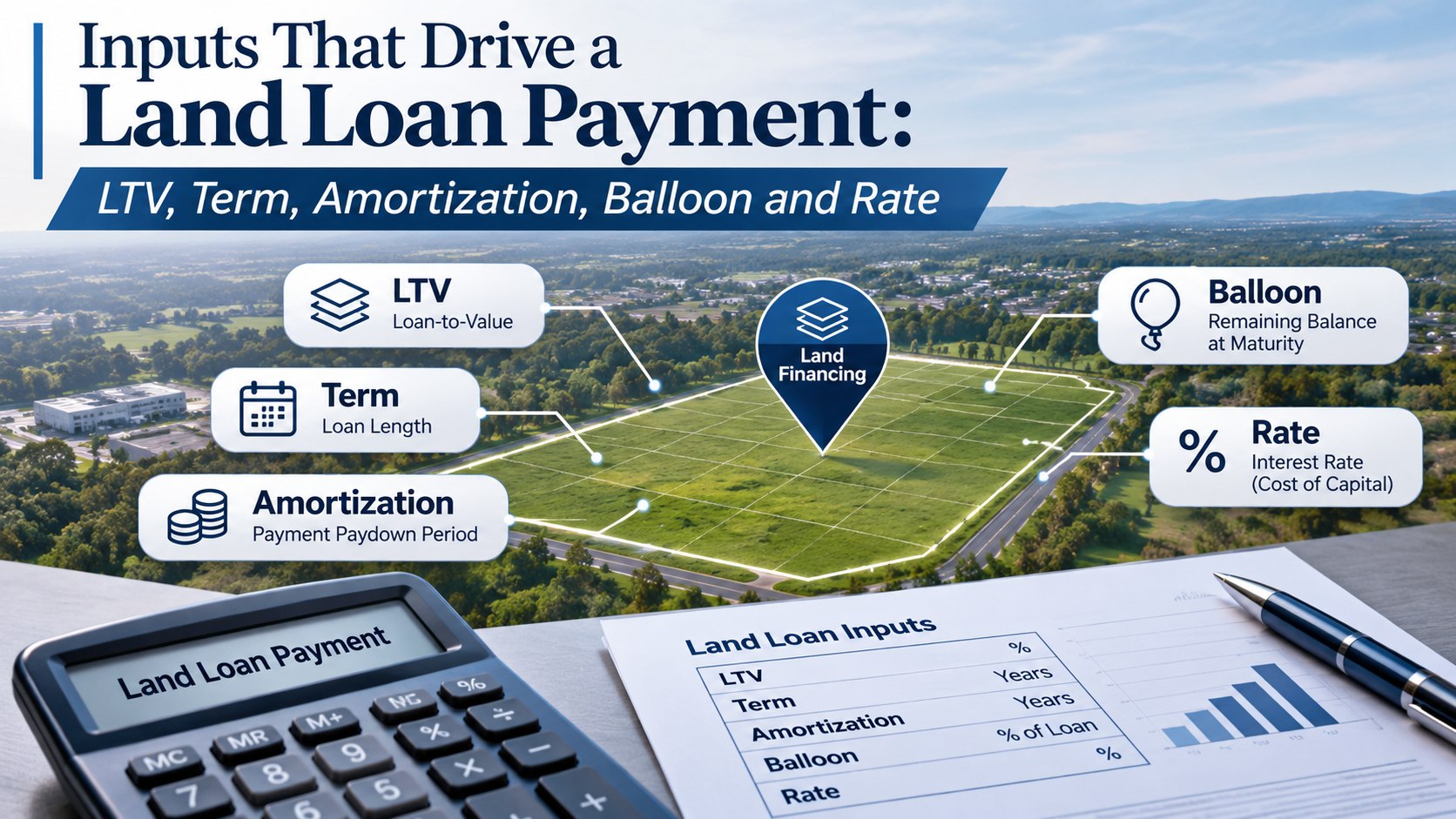
Inputs That Drive a Land Loan Payment: LTV, Term, Amortization, Balloon and Rate
A commercial land loan calculator is only as useful as the inputs behind it, and five of them do most of the work: loan-to-value, term, amortization, balloon structure and interest rate. Know how each one behaves before you open a tool, and you avoid the most common error, which is treating the monthly payment as the whole answer.
Loan-to-value sets the loan size. US lenders usually prefer an LTV of 50-80% for land, and most require a credit score of 650-700, according to LoopNet’s land loan calculator page. Those are US figures. LoopNet’s Canadian edition frames land financing differently: it describes raw land down payments of 30% to 50%, with repayment terms well under 15 years, and notes that the Business Development Bank of Canada (BDC) offers long-term commercial real estate loans of up to 25 years for land purchases or premises construction (LoopNet Canada). For a Canadian file, start from the Canadian ranges and treat the US figures as a comparison only.
Term and amortization are separate concepts, though calculators often blur them. Term is how long the lender’s commitment lasts. Canadian sources point to short terms on land: one broker guide describes vacant land mortgage terms of 1-5 years, and private land lenders commonly write terms of 6 months to 2 years (WealthNorth; LendCity). Amortization is the schedule used to calculate the payment, and bank land loans are typically cited at 15-25 years (WealthNorth). Amortization can move the monthly payment more than the interest rate does. Stretching it is a powerful lever, but it also breeds false comfort: a long amortization paired with a short term leaves a large unpaid balance at maturity.
That unpaid balance is the balloon. Balloon payments are a standard feature of commercial loans, so a good calculator shows the payment alongside the balloon amount due at the end of the term. The interest rate then ties everything together. Fixed commercial rates are generally priced off bond yields, while variable rates track prime, so enter the rate that matches the structure you are actually being offered.
One caution on method, and it matters more in Canada than in the US. Calculators differ in how they compound interest, and most of the free tools online are built on US monthly compounding. On a Canadian deal that is the wrong default, which is why the next section exists. Write down your own assumptions so your estimates stay comparable.
Canadian Commercial Land Loan Calculators: Compounding, Term vs. Amortization and Which Tools to Use
Most search results for “loan calculator” are US-built. A Canadian commercial land loan calculator should do three things differently.
1. Compound semi-annually on fixed rates. Section 6 of the federal Interest Act governs blended payments on Canadian mortgages. It requires the mortgage to state the rate on a yearly or half-yearly basis, not in advance, and as a result fixed-rate mortgage quotes in Canada use semi-annual compounding (Interest Act, Justice Laws; Mondaq). Variable-rate mortgages are the exception: they can compound semi-annually or monthly depending on the contract (WOWA). Confirm which applies to your term sheet.
The conversion is simple. With a quoted nominal rate i, the equivalent monthly rate is:
monthly rate = (1 + i/2)^(1/6) − 1
At a 6% quoted rate, that works out to an effective annual rate of 6.09%, and a monthly rate slightly below the 0.5% a US calculator would use (York University guide).
2. Separate term from amortization, and show the balloon. Canadian commercial loans are typically written with a contract term shorter than the amortization, with the remaining balance due at maturity. A calculator that only outputs a payment hides the real exposure.
3. Leave out the residential features. Many Canadian tools bundle CMHC default insurance and the mortgage stress test. Those are residential features. CMHC insurance is not available on vacant land (WealthNorth), so switch those options off or ignore that part of the output.
What is available. The tools below are the ones we found that handle Canadian compounding. We have not audited their math, so test any of them against the worked example in this article before relying on it.
- Clover Mortgage’s calculators apply semi-annual compounding and also include a land transfer tax and closing cost tool by province. They are built around residential purchases, so use the payment and balance logic and ignore the insurance features.
- Accurate Calculators’ Canadian loan calculator assumes monthly payments with semi-annual compounding.
- TaxTips.ca’s loan calculator lets you set the compounding frequency yourself, which makes it useful for checking another tool.
- LoopNet Canada’s land loan calculator is the closest to a land-specific tool, with guidance on land type, down payment and term.
None of these replaces a lender’s term sheet. Use them to size the question, then confirm with the lender.
Worked example: what Canadian compounding changes. Take a $600,000 land loan at a 7% quoted rate, amortized over 25 years, with a 5-year term. This is an illustration, not a rate quote.
| Canadian (semi-annual) | US-style (monthly) | |
|---|---|---|
| Effective annual rate | 7.12% | 7.23% |
| Monthly payment | $4,202.49 | $4,240.68 |
| Balloon at end of 5-year term | $546,267.57 | $546,972.91 |
The compounding difference is about $38 a month on this loan. The larger lesson is the balloon: after five years of payments, roughly 91% of the original loan is still owing. The payment looks like a 25-year loan, but the lender’s commitment is five years.
Step-by-Step: Running an Estimate Including Closing Costs and Balloon Payment
Run your commercial land loan calculator estimate in a fixed order so each figure feeds the next. This sequence keeps the numbers honest.
Start with the purchase price and a realistic value. Land produces no income, so the appraised value drives the loan. Use a conservative figure, not the asking price. Next, pick a target LTV or down payment. If you are unsure, run three cases across the range your lender type uses. For Canadian land, that means testing a down payment of 25%, 35% and 50% to see how sensitive the loan amount is (the Canadian ranges are in the next section).
Then enter the interest rate, the amortization period and the term as separate inputs. Use the amortization you expect to be offered and the shorter term you expect to sign. Check that the calculator uses semi-annual compounding for a fixed rate. It should return a monthly payment and, if it supports balloons, the balance remaining at the end of the term. If the tool has no balloon field, work out the term-end balance yourself from an amortization schedule so the maturity exposure stays visible.
Closing costs are the step people skip most often. The US benchmark is 3%-5% of the amount borrowed, according to Nationwide’s commercial mortgage calculator, but do not carry that range into a Canadian deal. Build the Canadian figure from its parts:
- Land transfer tax (Ontario). Ontario charges a graduated provincial land transfer tax. One calculator shows $12,475 on an $800,000 purchase, about 1.56% of the price (Clover Mortgage). That example is built on a residential purchase, so have counsel confirm the treatment for commercial land. Toronto adds a municipal land transfer tax on top.
- Other provinces. Alberta and Saskatchewan have no provincial land transfer tax and charge nominal land titles registration fees. In Alberta, one source puts the registration fee at about $50 plus $2 per $5,000 of value (EstatePass; Pegasus Lending). Prince Edward Island charges a real property transfer tax at 1% (WealthNorth).
- Legal, title and appraisal. The Canadian figures we found are residential: roughly $1,500-$2,500 for legal fees, $300-$500 for title insurance and $300-$500 for an appraisal (WealthNorth). Commercial land with an environmental review, survey and lender counsel will cost more. Get quotes.
- Lender fees. On short-term private land loans, one Canadian guide cites lender fees of 2-5% of the loan amount (LendCity).
- Sales tax. Whether GST/HST applies to a land purchase depends on the vendor and the property. Ask your lawyer before you finalize the cash figure.
Add closing costs to your cash requirement rather than to the loan, unless the lender explicitly agrees to finance them.
Finally, total the cash you need: down payment, closing costs and any reserves the lender requires. Compare that against the equity you actually hold. A payment that looks affordable can still fail at this step, which is why the cash-to-close figure deserves as much attention as the monthly number. If you want a second opinion on how these inputs interact, our Project Navigator™ capital-readiness diagnostic is built for that kind of assessment.
Down Payment and LTV Benchmarks for Raw and Improved Land (US and Canada)
Down payment expectations on land run heavier than on improved property, because the collateral is harder to value and harder to sell. Raw land is the riskiest collateral, with no road access, utilities or surveys. Improved land may earn better terms.
United States. One land acquisition guide from Crestmont Capital reports that raw land needs 35-50% down, while land with zoning approvals or infrastructure may need only 20-25%. The lesson is practical: entitlements and servicing reduce the equity a lender requires.
Canada. Canadian sources are consistent with each other, and they are land-specific:
| Land type | Typical down payment | Source |
|---|---|---|
| Raw land | 30%-50% (up to 50%), terms under 15 years | LoopNet Canada; WOWA |
| Serviced urban lot | 20%-30% | Spring Financial |
| Land loans generally (Ontario) | 25%-40% | WealthTrack |
| Bank land loans vs. home mortgages | 25%-50% vs. 5%-20% | WealthNorth |
| Private / short-term land loans | 25%-40% down, terms of about 1-3 years | WealthNorth |
Private lenders price this risk. One Canadian guide cites private land loan rates of 8%-14% and lender fees of 1%-3% of the loan (WealthNorth). Treat those as ranges to test, not quotes.
Two further points matter for a Canadian calculator run. First, the first-time-buyer 5% down payment rule applies to homes, not to land (Spring Financial). Second, for context beyond land, one Canadian lender reports a minimum down payment for commercial mortgages generally of 25% to 35%, and conventional commercial LTVs in Canada are commonly cited at 65%-75%, both for income-producing property. Those figures describe commercial mortgages in general, not land. We did not retrieve guidance from OSFI or CMHC, so none of these figures is a regulatory rule. They are market ranges from lenders and brokers.
For a Canadian land project, model raw land at 35%-50% equity and serviced, entitled land at 20%-30%, then confirm the actual terms with a lender. Our Our Process page outlines how we position a file before it reaches lenders, and that stage is often where equity assumptions get tested.
From Calculator Output to Lender Approval: Max Loan, DSCR and Debt Yield on Land
A calculator gives you a payment; a lender gives you an approval. The gap between them is underwriting, and land complicates it because there is usually no income to underwrite.
The sizing logic is straightforward. Maximum loan is the smaller of the LTV-based loan and the DSCR-based loan, and debt yield is NOI divided by the loan, per ZeroFlux’s commercial real estate loan calculator. On an income-producing building, both tests bite. On vacant land there is no net operating income, so the DSCR and debt yield tests have nothing to measure, and the loan is effectively sized by LTV against appraised value.
That does not make income irrelevant. Lenders often look to the sponsor’s other cash flow, to a guarantor, or to a development plan with a credible path to income. Where land is held ahead of construction, a lender may underwrite the borrower’s global cash flow rather than the parcel. In Canada, one broker guide notes that a land loan and the later construction loan may be written as a combined facility with the same lender, with the land value serving as collateral in place of cash for the equity requirement (LendCity; Spring Financial).
For context on what DSCR looks like where it does apply, Canadian minimums run from 1.10x for CMHC MLI Select to 1.20x-1.30x for Conventional A lenders. Private lenders generally have no formal minimum and focus on appraised value and LTV, typically 65-75% of as-is value, according to lendcity.ca. For land, that private-lender posture is the closest analogue: the asset and the equity cushion matter more than a coverage ratio.
So use a commercial land loan calculator to size the loan by LTV, and prepare a separate narrative on how debt service will be met. Strong land files tell that story clearly, and our Transaction Execution & Capital Structuring Services Agreement describes how we run that process for sponsors.
Balloon Refinance Risk and Rate Timing for Canadian Land Loans
The balloon is where a calculator’s tidy payment meets real-world risk. If your term is shorter than your amortization, a large balance falls due at maturity, and you must refinance, sell or repay it. No source we retrieved addresses how balloons interact with refinancing risk specifically on land, so this section reasons from first principles, from the worked example above and from the rate environment.
The risk has two parts. The first is rate risk: the refinancing rate at maturity may be higher than today’s. The second is value and qualification risk: the lender will reappraise, and land with no income must again clear an LTV test. If values soften or lender appetite for land tightens, the refinance can shrink or fail even when you have paid on schedule.
Rate timing matters now. The Bank of Canada raised its policy rate by 25 bps to 2.50% on October 28, 2026, according to RBC’s rate announcement page, and the same source shows 2.25% at every announcement before it in 2026. Policy rates move, so recheck that date-stamped fact before you rely on it. Variable-rate land loans track prime, so they react quickly to policy moves.
The stress test is easy to run. Using the same $600,000 loan, 25-year amortization and 5-year term, with Canadian semi-annual compounding, here is what a higher quoted rate does:
| Quoted rate | Monthly payment | Balloon after 5 years |
|---|---|---|
| 7% | $4,202.49 | $546,267.57 |
| 8% | $4,579.28 | $552,814.56 |
| 9% | $4,967.86 | $558,695.80 |
Each additional point adds roughly $380 to $390 a month and about $6,000 to the balloon. These figures show the sensitivity, not a forecast. The balloon moves less than the payment, which is the point: the maturity exposure is mostly a function of amortization and term, not the rate. Stress-test your commercial land loan calculator at a rate above today’s, both for the loan itself and for the maturity refinance.
Several habits reduce balloon exposure:
- Choose a term that gives your entitlement, servicing or construction timeline room to mature before the balloon falls due. With Canadian land terms often running 1-5 years, this is the most important decision in the structure.
- Keep a reserve sized for a partial paydown if the refinance comes in short.
- Understand the refinance mechanics. A cash-out or rate-and-term refinance replaces the existing loan and is sized against current value, and Wikipedia’s overview of cash-out refinancing gives a neutral definition of the concept.
Run the commercial land loan calculator at several rates, treat the balloon as a planned event rather than a footnote, and bring the output to a conversation about structure. If you want that conversation to be confidential and well prepared, contact us.