
Introduction
Most businesses do not fail to close a financing deal because the project is bad. They fail because the deal was never structured properly in the first place. That is the uncomfortable truth behind many declined term sheets, broken lender relationships, and projects that stall right before the finish line.
This is where the debate around capital advisory vs brokerage — and why sophisticated structuring is the only path to closing — becomes very real. Many owners and developers in Canada assume a capital advisor is just a fancier title for a broker. Both talk to lenders, both claim to know the market, both charge a fee at closing. On the surface, they look similar.
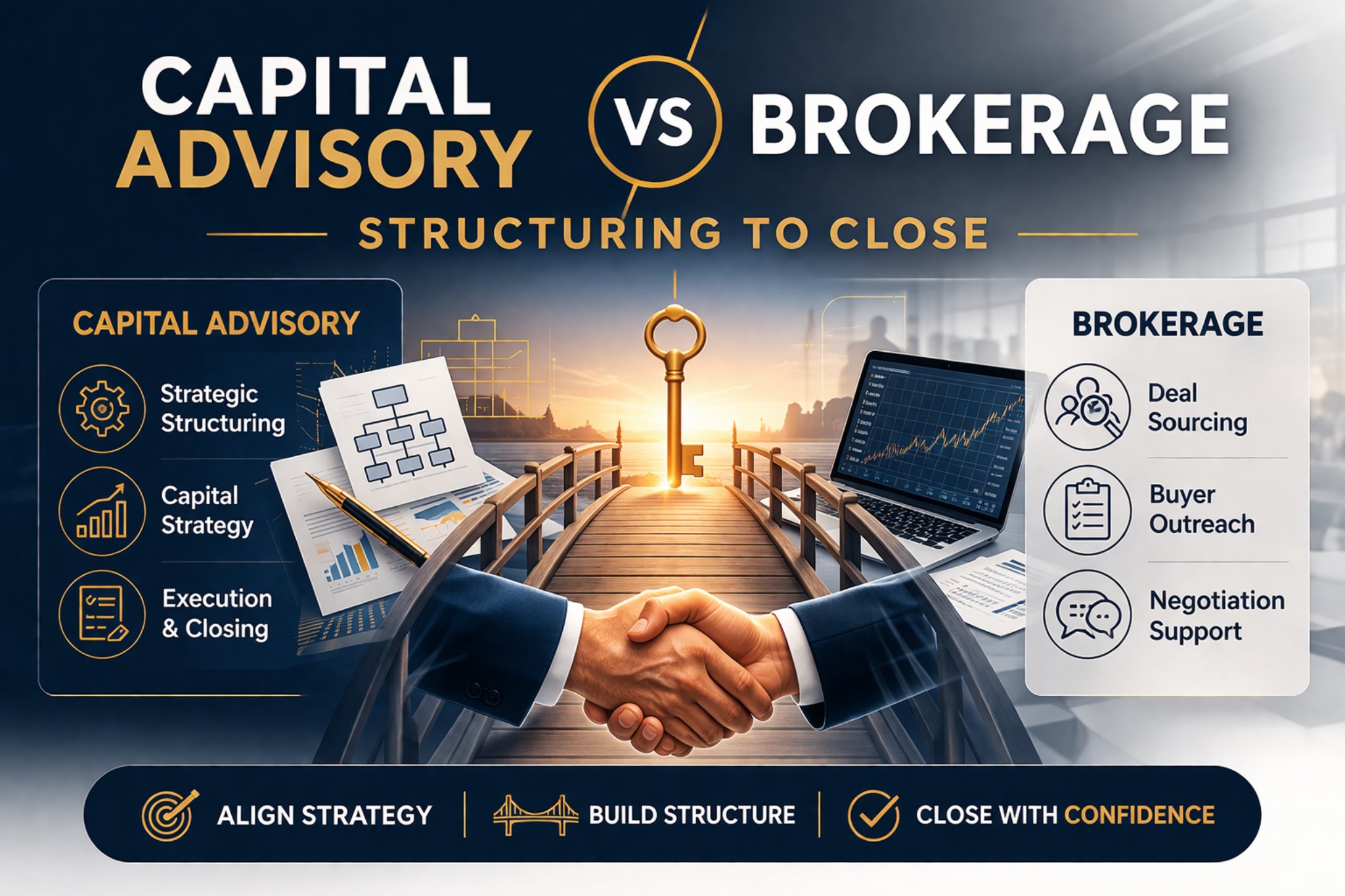
The cost of that confusion is measured in months of wasted time, multiple “no” decisions from banks, and deals that keep getting “almost there” but never funded. A broker focuses on who might lend. A capital advisor starts with how the deal must be structured so that the right capital providers can say yes.
“Risk comes from not knowing what you’re doing.”
— Warren Buffett
In commercial finance, not knowing how to structure a deal is exactly that kind of risk.
This article draws a clear line between transactional brokerage and true capital advisory. It explains what sophisticated structuring actually is, where standard brokerage breaks down, and why deals over $1 million in growth, acquisition, or project finance often need an advisory approach. For Canadian business owners, real estate developers, and investors, it shows why picking the wrong partner is not just a small mistake — it can be the difference between a closed deal and no deal at all.
Key Takeaways
Busy leaders often want the core message before they decide to read the detail. The points below summarize how advisory and brokerage differ when real capital is on the line.
- Capital brokers work on a transactional model and focus on matching a borrower with a lender. They take the request as given, package it, and send it to their network. They may compare rates and terms, but they usually do not redesign the underlying structure of the deal.
- Capital advisors start by designing the full financing structure before speaking with any lender. They look at the business, the project, and the long-term plan, then decide what type and mix of capital fits. Lenders are approached only after the structure and story are clear.
- Sophisticated structuring layers senior debt, mezzanine financing, and equity instruments instead of relying on a single lender. This approach often raises more total capital, improves the blended cost of funds, and makes deals work that a single bank would decline.
- Complex situations such as acquisitions, project finance, turnarounds, and high-growth capital needs sit outside the normal credit box. In these files, brokerage tends to stall, while advisory can redesign the structure so specialist lenders and investors can participate.
- Equis Capital Finance brings more than 20 years of principal experience structuring and closing commercial financings over $1 million across Canada and abroad. That experience sits at the advisory end of the spectrum, where sophisticated structuring is the core product, not an add-on.
Most Businesses Are Asking The Wrong Question When They Need Capital
When most owners decide they need money, the first question they ask is “Who will lend to me?” It sounds logical, but it sends them straight into a transactional process. They call a broker, describe the amount and asset, and wait to see which lender bites. The real question should be “What structure does this specific deal need in order to close on acceptable terms?”
A broker’s model fits that first question. A typical broker will:
- collect your financial statements, rent rolls, appraisals, and background information
- package the file according to standard lender templates
- send it to banks, credit unions, and possibly some private lenders
Their focus is on coverage of the market and speed to a term sheet, not on redesigning the request.
For simple, “vanilla” transactions, this can work very well. Refinancing a stabilized industrial building with strong cash flow and a low loan-to-value ratio is usually a straight line. In those cases, a broker can be a cost‑effective way to shop rates and find a lender that likes the asset class and borrower profile.
The structural issue appears as soon as the file stops being simple. A broker works for the transaction as presented. They rarely step back and ask whether the capital need is defined correctly, whether a different mix of debt and equity would serve the business better, or whether the story will stand up under deeper due diligence. The request is taken at face value and pushed through the system.
Compensation can make this worse. Many brokers are paid only on a success fee, as a percentage of the loan size. That model often rewards speed and volume ahead of careful structuring. It nudges them to place the deal “as is” with whoever will approve it, rather than question whether the structure is the right one for the client over the next five or ten years.
The tipping point comes when the deal does not fit neatly inside a single lender’s credit box. That includes non-standard assets, projected rather than historical cash flows, specialized industries, or capital needs that exceed one lender’s comfort level. In Canada, a large share of commercial financings over $1 million in growth, acquisition, or development settings fall into this camp. At that point, the question is no longer “Who will lend?” but “What structure will allow the right capital providers to participate?”
What Sophisticated Structuring Actually Means And Why Brokers Cannot Do It
Sophisticated structuring is the design of the entire financial architecture around a deal. It covers the capital stack, security, covenants, and instrument types in a way that matches the needs of the business and the risk and return expectations of each capital provider. It is not a quick rate negotiation. It is a discipline that sits closer to corporate finance than simple loan placement.
A clear way to see this is through the capital stack. Instead of one lender carrying the full risk, different layers of capital share it:
| Layer | Type | Risk Level | Cost Of Capital |
|---|---|---|---|
| Senior Debt | Bank or Credit Union | Lowest | Lowest |
| Subordinated / Mezzanine Debt | Private Debt Fund | Moderate | Moderate To High |
| Equity Or Preferred Equity | Investor or Partner | Highest | Highest |
By combining these layers, a capital advisor can often raise more total capital than a single lender would ever provide. The blended cost of funds can be lower than a pure equity raise, while still staying inside what senior lenders consider acceptable risk.
Structuring goes well beyond the mix of debt and equity. Lenders care deeply about covenants and security. A skilled advisor negotiates ratios such as Debt Service Coverage or Debt to EBITDA so they protect the lender without choking normal operations. They also design the security package so that assets are pledged in a way that satisfies each party while leaving the business room to move.
In many complex Canadian projects, pure debt alone will not support the required amount. That is where quasi‑equity instruments come in, such as convertible debentures, preferred shares, or project equity arrangements. Equis Capital Finance, for example, uses Project Equity structures to add funding when first mortgages are at their limit, sometimes with an option for equity conversion that aligns everyone’s interests.
True structuring starts with diagnosis, not distribution. Before a single lender sees the file, a capital advisor reviews:
- the business model and competitive position
- the management team and track record
- historic and projected cash flows
- major contracts, leases, and off‑balance‑sheet items
- tax position and long‑term growth plan
They build financial models that test different structures under stress. The result is a design that stands up when banks, private debt funds, and investors begin to pull it apart.
A broker submits an application. A capital advisor builds the case.
“The terms of a deal often matter more than the price.”
— Common saying among experienced investors
Sophisticated structuring is the work of getting those terms right.
When Brokerage Fails The Scenarios That Demand An Advisory Approach
Simple brokerage does not fail because brokers lack skill. It fails because complex files sit outside what the brokerage model is built to handle. When a deal needs to be re‑designed, not just re‑shopped, a different approach is required.
Three common scenarios show where capital advisory makes the difference:
- Value‑Add Real Estate DevelopmentA Canadian developer acquires an underperforming retail plaza with plans to reposition it as a mixed‑use property with residential units above. Traditional banks see limited in‑place cash flow, entitlement risk, and a speculative business plan, so they decline. A broker sends the same package to more lenders and gets the same outcome.A capital advisor instead structures a phased plan, with private debt for acquisition risk, a construction facility from a credit union tied to pre‑leasing targets, and a take‑out mortgage once the asset is stabilized. The same project, reframed through structure, now closes.
- Management Buyout With A Collateral GapA strong operating team wants to buy the business they run. The company shows consistent earnings but has few hard assets and a high goodwill component in the purchase price. Banks view this through an asset‑based lens and fall short of the required leverage. A broker has nowhere else to go.A capital advisor reframes the file as a cash‑flow deal, brings in a private credit fund to provide a unitranche facility priced off earnings, and adds a small equity slice to complete the stack. The owner exits, management takes control, and the lender is paid from future cash flow.
- Large Projects In Non‑Traditional SectorsA third example is a large project in a non‑traditional sector such as healthcare, energy, or mining that needs more than $10 million. The file calls for a mix of senior debt, subordinated facilities, and project equity, often with non‑recourse features and high loan‑to‑cost ratios. Most banks in Canada and abroad pass, not because the project has no merit, but because it does not sit within their standard product set.A capital advisor with a structured finance platform, like Equis Capital Finance, can approach pension funds, insurance companies, private lenders, and specialized credit programs and design a stack that shares the risk in a way each party can accept.
If a recent financing discussion ended in a “no,” it is worth asking a simple question: was the project itself rejected, or was it just never structured in a way that serious capital providers could support?
Why Equis Capital Finance Is Built For Complexity
Equis Capital Finance sits firmly on the advisory side of the line. For more than 20 years, its principals have originated, negotiated, structured, and closed commercial loans over $1 million across alternative real estate finance, project finance, and venture capital. That history is hands‑on principal experience, not just arranging other people’s deals.
The firm works across the full capital stack. That includes:
- traditional bank and credit union lending
- asset‑based facilities
- subordinated and mezzanine debt
- project equity
- securitization structures
For international projects, Equis handles funding requests from $3 million USD and up in regions such as Canada, the Caribbean, Mexico, and Europe, applying the same structuring discipline used at home.
Specialized groups inside the firm focus on complex needs:
- The Construction Finance Group develops non‑recourse, high loan‑to‑cost products for qualified developments.
- The Private Capital Group concentrates on non‑bank financing for projects that fall outside standard lending policies but still have strong fundamentals.
Behind these services sits a broad funding network. Equis maintains active relationships with banks, credit unions, trust companies, insurance companies, pension funds, and private lenders across North America and key international centres. As an independently owned advisory firm, it is not tied to any one lender’s balance sheet, so recommendations are based on what best fits the client’s structure.
Equis Capital Finance does not simply broker deals. It structures closings.
Conclusion
The gap between a closed transaction and a failed one is rarely the quality of the project on its own. Again and again, the real difference is the sophistication of the structure that sits around it. Brokerage is, by design, a transactional service. Capital advisory is a strategic function that reshapes the request so serious lenders and investors can say yes.
For straightforward, low‑risk files, a broker can still be a sensible option. But once a deal involves growth, acquisition, project development, non‑standard assets, or multiple capital layers, sophisticated structuring stops being a nice extra and becomes mandatory.
If your next financing carries any degree of complexity, it deserves a capital advisor, not just a matchmaker. Connect with Equis Capital Finance to discuss how sophisticated structuring can position your transaction for a successful close.
FAQs
What Is The Difference Between A Capital Advisor And A Mortgage Broker In Canada?
A mortgage broker focuses on matching a defined loan request with a lender from their panel. They package your information and shop it for the best rate and terms they can find. A capital advisor designs the full financing structure first, including the capital stack, covenants, and security, then approaches the right mix of lenders and investors. That distinction becomes very important for commercial transactions over $1 million with any level of complexity.
When Does A Business Need A Capital Advisor Instead Of A Broker?
A business needs advisory support when standard lenders have already said no, or when the file involves more than a simple term loan or mortgage. That includes growth stories, acquisitions, project developments, turnarounds, and any situation where the required capital is higher than a single lender will advance. It also includes deals with multi‑party negotiations, complex security, or covenants that need senior financial expertise to shape properly.
What Is Sophisticated Deal Structuring In Commercial Finance?
Sophisticated structuring means designing the full capital stack for a transaction, from senior bank debt through subordinated or mezzanine facilities to equity and quasi‑equity instruments such as convertible debentures or preferred shares. It also means negotiating security, covenants, and repayment terms so they fit the day‑to‑day operations of the business. In short, it is the process of making a complex or non‑standard deal acceptable to capital providers, and it sits at the core of capital advisory work rather than brokerage.
Does Equis Capital Finance Work With Businesses Outside Of Canada?
Yes. Equis Capital Finance works on international funding mandates starting at $3 million USD. Current focus regions include Canada, the Caribbean, Mexico, and parts of Europe. Cross‑border transactions are handled with the same structuring discipline and advisory depth as domestic Canadian deals.