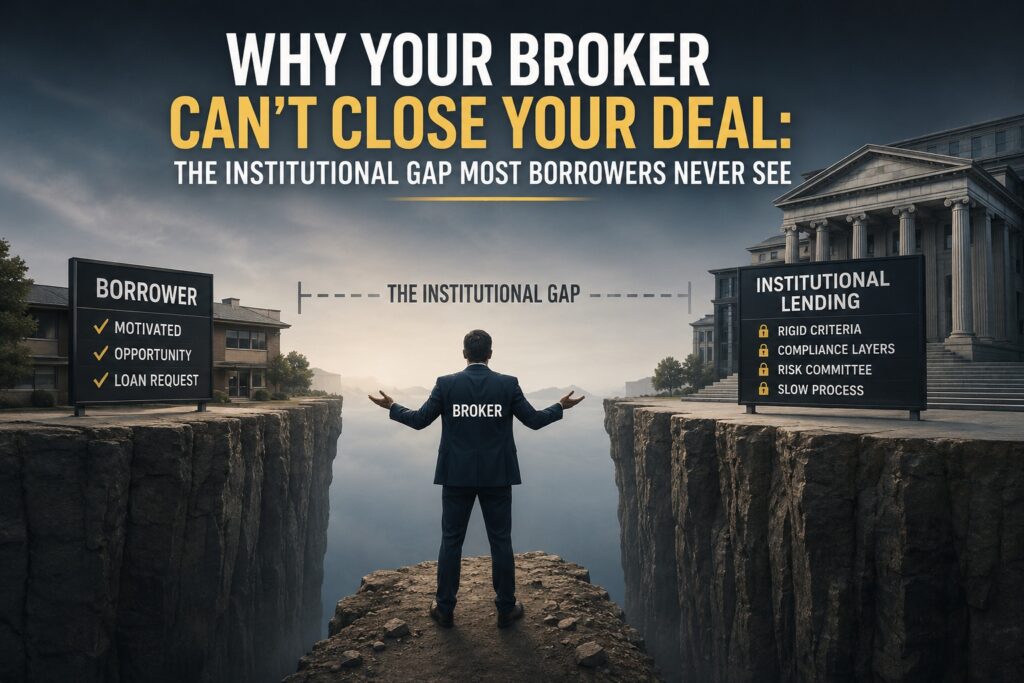

There’s a moment that happens in almost every deal I get called into after it has already gone sideways.
The borrower is frustrated. The file is stale. And somewhere in the paper trail, there is a broker who was confident, well-meaning, and completely unprepared for what it actually takes to get a deal to a closing table.
This is not a knock on effort. Most brokers work hard. They hustle for leads, build relationships, and know how to sell. What many do not know — and what almost nobody teaches them — is how capital actually moves.

Sourcing a Lead Is Not the Same as Structuring a Deal
The broker industry has quietly conflated two very different skill sets: origination and execution.
Origination is finding the deal. Execution is getting it funded.
A broker can be exceptional at the first and dangerous at the second.
Getting a deal funded requires understanding how a capital source actually underwrites risk — not how the borrower describes the opportunity, but how a credit committee, investment committee, or institutional lender will actually stress-test it.
It requires knowing which structure fits which capital source, what documentation a file needs before it is even shown, and how to sequence a transaction so it does not collapse under its own weight three weeks before closing.
None of that is intuitive. None of it is taught in a weekend course. And most of it is only learned by watching deals die.

The Symptoms Show Up Late
The problem with under-qualified deal execution is that it does not announce itself early.
A poorly structured file can look fine for months. The broker sends emails, schedules calls, keeps the borrower engaged, and everyone feels like progress is being made.
Then the file actually reaches a capital source with real underwriting standards, and the cracks appear all at once:
- The financials do not match the narrative.
- The collateral position was never properly disclosed.
- The use of proceeds shifts depending on who is asking.
- The timeline everyone was promised was never realistic in the first place.
By the time this surfaces, the borrower has usually lost months, sometimes paid fees they cannot recover, and — worst case — signed something they should not have.

Why This Keeps Happening
There are three main reasons this continues to happen.
First, the barrier to calling yourself a broker is almost nonexistent.
Anyone with a phone and a LinkedIn profile can position themselves as a capital advisor. There is no equivalent of a bar exam for deal structuring.
Second, the incentive structure often rewards activity over outcomes.
A broker who sources ten leads and gets paid retainers on intake has a very different motivation than one who only gets paid when a deal actually closes. When the business model does not require competence to generate revenue, competence becomes optional.
Third, most brokers have never sat on the other side of the table.
They have never had to defend a file to an investment committee or explain a deficiency to a lender’s credit team. Without that experience, it is genuinely hard to know what a fundable file even looks like.

What Actually Getting a Deal Funded Requires
A deal that closes — reliably and without unnecessary drama — usually has a few things in common, regardless of asset class or geography.
A defined process, followed in order.
Deals do not get funded because someone was persistent. They get funded because the file was built correctly, in sequence: proper engagement, a clean and honest Confidential Information Memorandum, a due diligence package that anticipates questions instead of reacting to them, and submission only to capital sources that are actually suited to the transaction.
Honest structuring, even when it is not what the borrower wants to hear.
Sometimes the right answer is telling a client their request is not fundable as proposed. A broker who cannot have that conversation is not protecting the client — they are setting them up to waste time chasing capital that was never going to say yes.
Discipline around disclosure.
Every material fact — every lien, every prior default, every complication — needs to be on the table before a capital source commits time to underwriting. Deals that hide problems do not avoid them. They simply delay them until the cost of discovery is higher.
Real relationships with real capital, not a spray-and-pray approach.
There is a meaningful difference between a broker who has cultivated actual relationships with capital sources that trust their files, and one who is blasting the same deck to fifty inboxes hoping something sticks.

What This Means If You Are a Borrower
If you are evaluating a broker or capital advisor, ask harder questions than, “Can you get this done?”
Ask how they structure a file. Ask what happens if a lender comes back with a deficiency. Ask how many of their deals actually reach a closing table versus how many simply get shopped around.
A broker who can answer those questions specifically, with process and precedent, is worth your time.
A broker who answers with confidence but no specifics is a risk you are taking on, whether you realize it or not.

The Standard Should Be Higher
Deal-making is not supposed to be easy, and it should not be treated like it is.
The businesses and projects on the other end of these transactions — payrolls, developments, acquisitions, and people’s livelihoods — deserve advisors who understand what it actually takes to move capital, not just what it takes to sound like they do.
The hard truth is not meant to be discouraging. It is meant to be a filter.
The market rewards the brokers who do this properly.
Everyone else eventually gets found out — usually at the worst possible time, in someone else’s deal.

At Equis Capital Finance, we believe capital advisory should be disciplined, transparent, and execution-focused.
We do not simply “shop deals.” We help structure them, prepare them, and position them properly before they are introduced to the right capital sources.
If you are a borrower, developer, business owner, or advisor with a transaction that requires serious capital execution, contact Equis Capital Finance to discuss whether your file is truly capital-ready.
Equis Capital Finance
Private Capital. Structured Properly.