
Introduction
Loan offers keep falling short even when your project is real and demand is obvious. The real blocker is not capital; it is readiness.
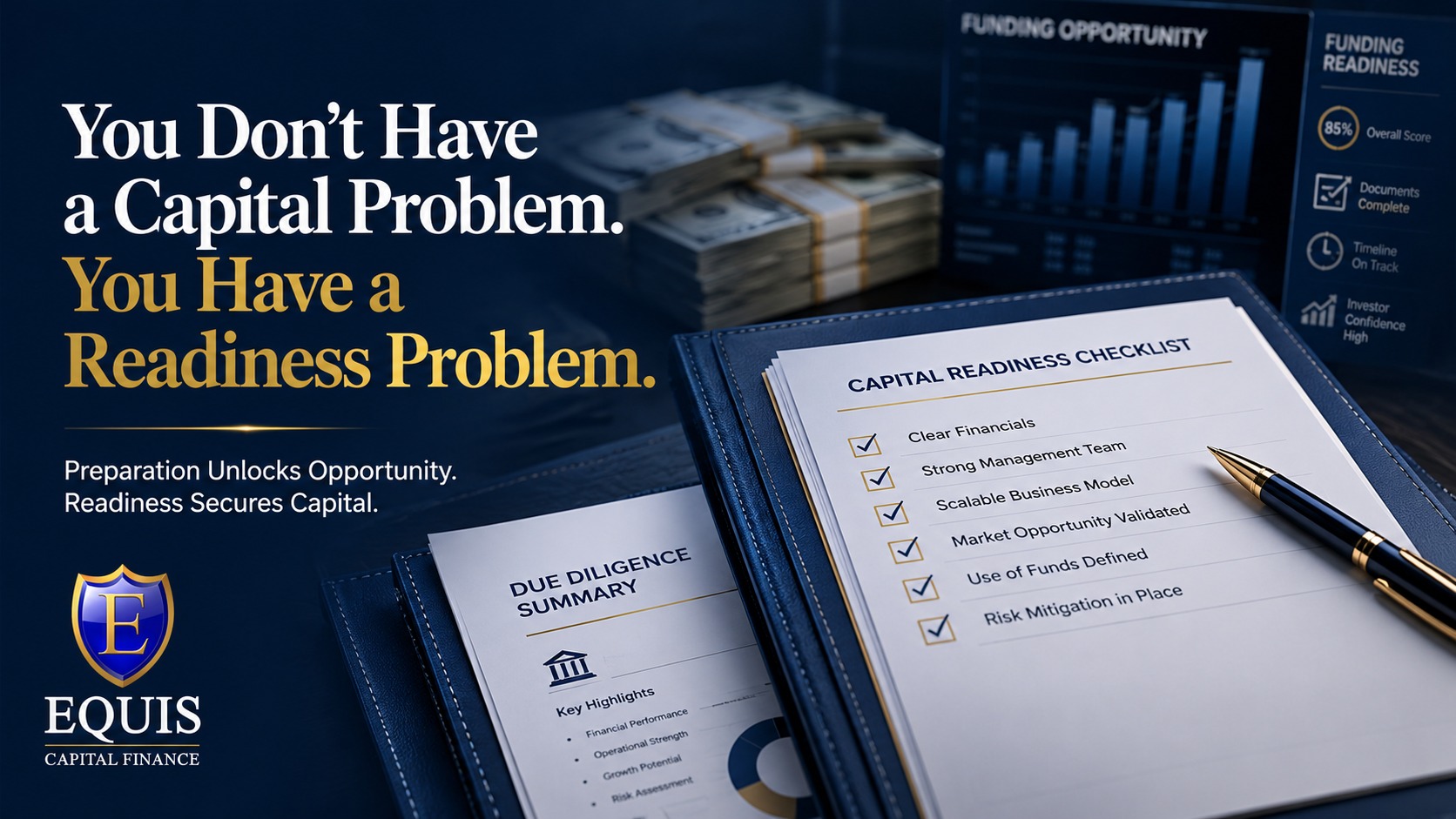
A Capital Readiness Assessment shows whether your business meets lender standards before any file goes out. It checks structure, documentation, and sponsor strength. This article explains that checklist and how Equis Capital Finance uses it for Canadian borrowers.
If financing is on your horizon, pause before calling lenders. Start by reading this readiness map so your first shot counts and your name lands on the right side of the credit officer’s notes.
“Banks do not just lend on projects; they lend on the people and records behind those projects.”
— Common credit officer saying
Key Takeaways
Here is what you can expect from the next sections.
- You see what a Capital Readiness Assessment actually reviews. It covers numbers, structure, legal standing, and sponsor strength, so you know exactly where lenders look first.
- You understand that lenders usually reject submissions, not businesses. Weak packaging or missing pieces get turned down even when the opportunity has merit. That difference shapes how you prepare.
- You learn the cost of walking in early. A poorly timed approach can harm your reputation with banks and private lenders. In Canada’s tight market, that history follows you.
- You see how Equis Capital Finance structures the readiness process. Internal tools and checklists replace guesswork with a clear action plan. That preparation gives your file a very different reception.
What Is A Capital Readiness Assessment — And Why Does It Come First?

A Capital Readiness Assessment is a structured diagnostic that checks if your business can realistically attract debt or equity capital. It comes first because it shows whether a transaction is financeable, how it should be structured, and which capital paths make sense.
Unlike a loan application, this assessment does not go to Royal Bank of Canada, TD Bank, or other lenders. It is an honest pre-screen that reviews your cash flow, collateral, legal standing, tax status, and business plan against the standards credit teams at these institutions expect. You learn whether capital is achievable now, what level of debt is realistic, and what must change before a serious approach.
During the review, you answer practical questions such as:
- Is your revenue trend stable enough to support scheduled payments?
- Are your leases, permits, and shareholder agreements in proper order?
- Does your business have the equity or deposit that lenders such as Scotiabank or Desjardins usually expect?
Those answers shape not only whether you can proceed, but also how much to request and on what terms.
In Canada, small and medium enterprises represent about 98 per cent of employer businesses, according to Statistics Canada, so competition for attention is intense. Research by Business Development Bank of Canada lists access to financing among the top growth obstacles for these firms. When an underprepared sponsor sends a weak file to multiple banks and credit unions, that story travels fast through lending desks and groups such as the Canadian Venture Capital and Private Equity Association. Starting with a private Capital Readiness Assessment, like the one Equis Capital Finance uses for every new client, protects your reputation and keeps you out of that informal penalty box.
The same logic applies whether your target is a Business Development Bank of Canada program or financing under the Canada Small Business Financing Act. If the file is not ready, it will not move past intake staff, regardless of how strong the project feels on the ground.
“What gets measured gets managed.”
— Peter Drucker
A readiness review is how you measure your file before credit teams do.
What Are Lenders Actually Evaluating? The Five C’s Of Credit

When a lender reviews your file, the Five C’s of Credit frame almost every question the underwriters ask. These five factors describe how ready both you and the project are for institutional money.
Capacity is the income side of the story, the cash flow that must cover new debt along with existing obligations. Credit teams at institutions like Bank of Montreal and CIBC study your historical statements, projected rent rolls, and stress scenarios to see whether payments fit under realistic conditions.
Capital refers to your own money in the deal. Lenders want to see that you, the sponsor, have meaningful equity at risk instead of treating their funds as the only skin in the game. For commercial real estate, that often means a solid deposit plus soft costs already paid from your own balance sheet.
Character is about trust. Underwriters look at your track record, references, and experience in the sector, whether that is multifamily housing, retail plazas, or an operating company. A clear, transparent explanation of past issues, such as a prior workout, often helps more than silence.
Collateral is the secondary way the lender expects to be repaid. This usually means the property or equipment they finance, but sometimes also personal guarantees or additional security. Strong collateral can offset weaker aspects of the file, especially with alternative lenders and mortgage investment corporations.
Conditions describe the purpose of the money and the economic context around it. A request for working capital to support a growing export client base will be viewed differently from a speculative land assembly. Interest rate trends tracked by the Bank of Canada, local vacancy rates, and sector risks all feed into this lens.
Many owners focus only on the dollar amount requested, yet institutional lenders evaluate the sponsor through all Five C’s together. Research from Equifax Canada shows that consistent payment history is the single biggest factor in most credit scores, which feeds directly into both capacity and character. A Capital Readiness Assessment translates these lender priorities into a clear checklist, so your submission speaks the same language as the credit committee.
Tip from Equis Capital Finance:
“Before you ask for new debt, review the Five C’s as if you were the lender. Any point that would make you hesitate will probably concern them even more.”
The Six Readiness Gaps That Lead To Rejection

Readiness gaps are the disconnects between what you send and what lenders expect to see. They are the practical reasons otherwise sound deals stall, receive partial approvals, or come back with expensive terms.
According to Statistics Canada, around one in five small and medium enterprises that seek external financing report being turned down or only partly approved. Weak documentation and poor deal structure, not just market conditions, sit behind many of those outcomes. Here are six gaps that Equis Capital Finance sees most often across both operating companies and real estate sponsors.
- Financial Documentation Gap
Many borrowers submit spreadsheet printouts or tax returns without clear income statements and balance sheets. Underwriters cannot rely on numbers that mix personal and business expenses or skip key notes. Clean, accountant‑prepared statements, plus realistic projections, close this gap. - Capital Stack Structure Gap
A deal that leans too heavily on senior debt with almost no true equity looks fragile. Lenders want to see debt, mezzanine pieces, and investor equity aligned with policy limits. When the stack is reshaped so each layer carries a reasonable share of risk, the same project often becomes financeable. - Business Planning Gap
Many sponsors send glossy pitch decks that excite customers but do not answer lender questions. Credit teams need written assumptions, downside cases, and clear use of funds, not just market optimism. An institutional‑grade business plan and information memorandum fills that missing piece. - Legal And Regulatory Gap
Missing incorporation documents, unsigned shareholder agreements, or lapsed real estate licences delay underwriting. Lenders also check that required provincial and municipal permits are active. Pulling this paperwork together before outreach keeps files from sitting idle on a credit officer’s desk. - Tax Compliance Gap
Outstanding HST or payroll remittances signal deeper problems, especially when the Canada Revenue Agency has already issued warnings. Even if a payment plan exists, surprises in this area scare lenders. Clear statements of account and proof of current filings reduce that concern. - Personal Financial Profile Gap
For many owner‑managed businesses, personal credit and net worth matter as much as corporate numbers. A weak credit score, undisclosed liabilities, or past bankruptcy with no context can sink the file. Pulling current bureau reports and preparing a frank explanation of any past issues turns this from a mystery into a manageable risk.
A disciplined Capital Readiness Assessment exposes these gaps early. That gives you time to clean records, adjust structure, or even delay the raise rather than collect fast rejections that will follow your name.
“An application that is 90% right still reads as 100% risky if the missing 10% sits where lenders expect the most clarity.”
— Senior commercial banker, quoted by Equis Capital Finance
How Equis Capital Finance Closes The Readiness Gap

Equis Capital Finance closes the readiness gap by acting as a lender‑side advisor, not just an introducer. The firm focuses first on whether a deal is ready for capital, then on which sources make sense.
Every client mandate starts with a Capital Readiness Assessment that reviews feasibility, capital structure, sponsor strength, and documentation. Using this internal scorecard, Equis decides whether to move forward now, pause for cleanup, or reshape the ask. That approach protects clients in a market where banks, credit unions, and private lenders from groups like the Canadian Venture Capital and Private Equity Association talk to each other regularly.
Once the file is ready in principle, the Project Navigator™ tool maps a realistic route from proposal to closing. It compares the project to current appetite at institutions such as Business Development Bank of Canada, regional credit unions, pension‑backed lenders, and private debt funds. The output is a concrete plan that links facility types, debt levels, covenants, and likely pricing.
Equis then helps prepare investor‑grade business plans, stress‑tested financial projections, and concise information memorandums written in the language credit committees expect. Where needed, Transaction Execution and Capital Structuring services realign the full capital stack so senior debt, mezzanine tranches, and equity backers all fit lender policies. According to Business Development Bank of Canada, weak financial management ranks among the top reasons small firms fail, so this disciplined preparation directly supports long‑term strength.
With more than twenty years working on commercial financings from 1 million to 500 million dollars across Canada and the United States, Equis Capital Finance knows which desks are active for multifamily housing, industrial facilities, or mid‑market operating companies. Specialist teams such as the Construction Finance Group and Private Capital Group broaden the lender universe far beyond the high‑street banks. Clients arrive at lender meetings with answers ready, not scrambling for missing pieces.
The Bottom Line
The bottom line is simple. For most sponsors, the obstacle is not a shortage of money in the market; it is a shortage of readiness.
Banks, credit unions, mortgage investment corporations, and private funds all need well‑prepared borrowers. When files arrive with clean numbers, clear structure, and a thoughtful story, capital tends to follow. When they arrive messy or incomplete, even strong projects are pushed aside.
Conclusion

Capital readiness is not a one‑time checklist; it is a habit of running your business to institutional standards. When you keep financials current, stay on top of tax obligations, and think about capital structure early, each future raise becomes easier and cheaper.
Equis Capital Finance exists to guide that process for property owners, developers, and business operators across Canada and the United States. By starting with a disciplined Capital Readiness Assessment and tools like Project Navigator™, the firm helps you decide whether to advance, adjust, or delay a raise before lenders ever see the file. That protects your reputation in a tightly connected market.
If you are planning construction financing, refinancing, or a major corporate transaction, resist the urge to send a half‑ready deck to dozens of contacts. Sit down for a readiness review first so your next submission looks like it belongs on a credit officer’s desk. When you do approach lenders, you will be asking for capital, not for patience.
Frequently Asked Questions
These questions come up most often when Canadian owners work through a Capital Readiness Assessment with Equis Capital Finance.
Question 1: What Is A Capital Readiness Assessment?
A Capital Readiness Assessment is a structured diagnostic review of your business and project before lenders see the file. It evaluates financials, legal standing, tax compliance, capital structure, and sponsor strength, then outlines what must change so you can approach banks or private lenders with confidence.
Question 2: Why Do Most Canadian SMEs Get Rejected For Financing?
Most Canadian SMEs are rejected because of weak documentation, unclear deal structure, or submissions written for a sales audience instead of a credit committee. Statistics from Statistics Canada show about one in five applicants are turned down or only partly approved, often for these readiness reasons rather than a true lack of capital.
Question 3: What Is Project Navigator™?
Project Navigator™ is Equis Capital Finance’s readiness review tool for specific transactions. It tests feasibility, reviews the capital stack, compares the file to current lender appetite, and lays out a step‑by‑step path from proposal to closing so you know which institutions to approach and in what order.
Question 4: How Is Equis Capital Finance Different From A Traditional Mortgage Or Business Broker?
Equis Capital Finance leads with advisory work on readiness and structure instead of pushing volume through a small group of lenders. The firm covers the full capital stack across banks, credit unions, private lenders, and funds, and takes on complex, time‑sensitive, or unconventional financings that many brokers quietly avoid.
Question 5: Does Completing A Capital Readiness Assessment Guarantee Financing Approval?
Completing a Capital Readiness Assessment does not guarantee approval, because each lender applies its own underwriting rules. It does, however, lift the quality of your submission, reduce avoidable red flags, and improve your chances of receiving timely, well‑priced offers instead of costly rejections.