
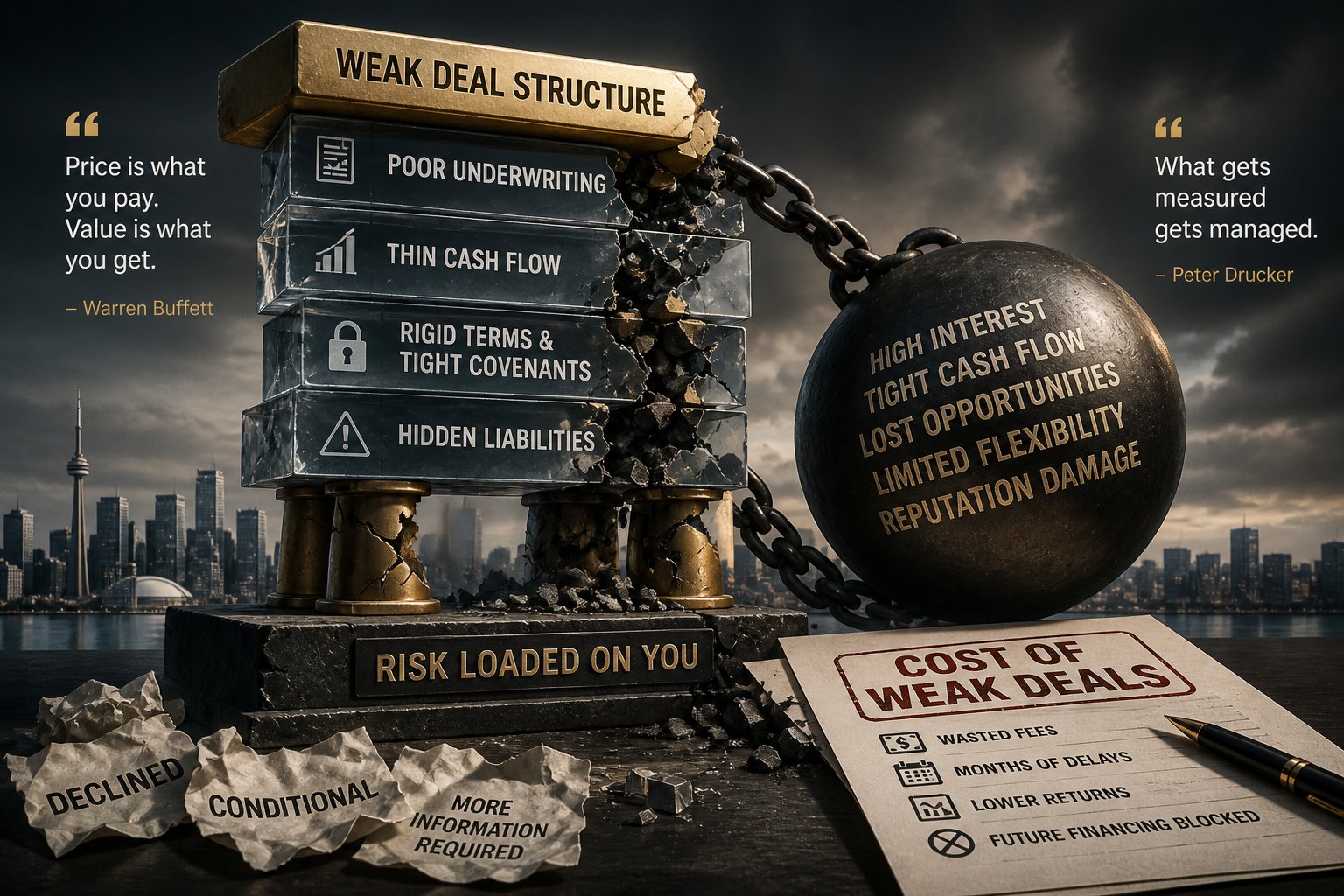
If a broker pushes generic terms, cannot explain how the debt gets repaid, and rushes you to sign, the structure is already off track. Those early signs often show up long before a lender declines the file. When they are ignored, the cost of weak deals includes wasted fees, months of delays, and damage to your reputation with lenders and partners.
When that file keeps bouncing between credit departments while your closing date creeps closer, stress rises and opportunities start slipping away.
A weak deal is a structure that loads risk onto you, leaves cash flow too thin, and blocks future financing, even if it closes. This article breaks down how that happens in Canadian real estate and business finance, the real cost of weak deals, why standard brokers struggle, and how stronger structuring fixes it. You will also see how Equis Capital Finance approaches complex files that others could not close.
Now, let us look more closely at what a weak deal actually is.
Key Takeaways
- The real cost of weak deal structuring goes far beyond one failed closing. It shows up as higher interest costs, tight cash flow, and lost future lending options. Over time, it eats away at both returns and flexibility.
- Traditional brokers often rely on rigid bank programs and surface level underwriting. They rarely rebuild forecasts or the capital stack. That makes them fragile when lenders tighten criteria or when a project has any unusual risk.
- Poor financing structures erode margins from day one. Even a slightly higher rate or shorter amortization can pull hundreds of thousands of dollars out of a multi million dollar deal. That trapped cash could have funded better projects.
- Strong business deal structuring starts with stress testing, clear legal terms, and independent valuation. Deals should still work after a revenue drop or interest rate jump. When those tests are done upfront, surprise problems later are far less likely.
- Equis Capital Finance works as a boutique investment banking and consulting partner, not just a broker. The firm restructures projections, redesigns capital stacks, and taps a wide North American funding network so deals that stalled at banks can move forward on stronger terms.
What Is a Weak Deal and Why Does It Cost You More Than You Think?

A weak deal is a transaction where the risk, return, and structure are out of balance, even if the surface numbers look fine. In Canadian commercial real estate and mid market business finance, that usually means thin cash flow, rigid terms, and poorly analysed downside scenarios. When those elements combine, the cost of weak deals can exceed any broker fee or legal bill.
At the core, these deals share four traits:
- Risk sits mostly with the borrower, while lenders and investors are heavily protected.
- Terms are rigid, with short amortizations, tight covenants, and little room to manage a downturn.
- Underwriting is shallow, built on optimistic rent growth, rosy sale assumptions, or untested business plans.
- Due diligence is rushed, so environmental, tax, or operational issues stay hidden until after closing.
Psychology makes this worse. Owners and sponsors feel pressure to secure rare assets in cities like Toronto, Vancouver, or Montréal, so they accept weak structures to “win” the property. Once legal and third party costs are sunk, people feel they must close, even if new information looks bad. That sunk cost mindset keeps many borrowers moving ahead on fragile terms.
Research from Harvard Business Review estimates that 70 to 90 percent of acquisitions fail to meet their original objectives, with poor deal design a major factor. In other words, the headline price is rarely the main problem. The real damage comes from accepting structures that cannot handle rate changes from the Bank of Canada, tenant turnover, or slower sales.
“Price is what you pay. Value is what you get.” — Warren Buffett
Strong sponsors focus on the value of the structure, not just the price on the front page of the purchase agreement.
How Weak Deal Structuring Drains Your Finances – Immediately and Over Time
Weak commercial deal structuring starts draining money on day one. When loan terms, purchase price, and operating assumptions are out of line, margins shrink and cash flow turns tight. In that setting, even small surprises create big headaches.
One of the fastest ways this shows up is in debt service. A difference of only 50 to 100 basis points on a ten million dollar loan can add hundreds of thousands of dollars in interest over the life of the facility. According to McKinsey & Company, firms with disciplined capital allocation practices deliver several percentage points more in shareholder returns than peers, largely because they avoid these hidden financing leaks. Short amortizations and aggressive debt service coverage ratios make things worse, leaving very little buffer if rent or revenue slips.
“What gets measured gets managed.” — Peter Drucker
If you are not carefully measuring financing terms, covenants, and downside cases, you cannot manage the risks they create.
Hidden liabilities are another silent drain. In real estate, that might be underestimated capital expenditures on roofs, mechanical systems, or environmental clean up. In business acquisitions, it could be unpaid tax with the Canada Revenue Agency, pending lawsuits, or obsolete inventory. Once those costs surface, they hit cash flow that was already committed to servicing debt.
Over time, the picture gets tougher. High debt levels and weak terms increase the risk of breaching EBITDA or loan covenants with banks like RBC, TD, or BMO. That can trigger penalty rates, cash sweeps, or forced refinancings at the worst possible moment. Lower earnings and a strained balance sheet then reduce valuation, which in turn limits access to favourable credit from lenders, private equity funds, or pension fund investors such as CPP Investments.
The Hidden Tax – Opportunity Cost and Trapped Capital

Beyond direct losses, weak deal structuring creates an invisible tax on your growth. Capital, management time, and borrowing capacity become trapped inside underperforming assets or low margin contracts. That opportunity cost rarely appears on financial statements, but it is very real.
Take a Canadian example reflecting current Vancouver Commercial Real Estate dynamics: an investor locks into a Class C office building at a low cap rate, with short leases and large upcoming capital needs. Because the loan from a major bank is tight on covenants, refinancing is nearly impossible. When a high yielding distressed asset appears a year later, that investor has no liquidity or borrowing room left to pursue it.
According to recent analysis of Commercial Real Estate Investment in Canada, billions of dollars in commercial real estate trade hands every quarter, much of it in situations where speed matters. If your resources are stuck in weak structures, there is no way to act when those windows open. The popular idea that any deal is better than no deal sounds bold, but in practice it drains reserves and accelerates burnout while stronger competitors wait patiently for better opportunities.
Why Your Broker Is Often the Weakest Link in the Deal
Traditional brokers often become the weak point in complex financings because their process is built around product, not structure. They focus on matching your file with the closest bank program, instead of asking whether the deal itself truly works. That habit quietly increases the cost of weak deals for business owners and developers.
Most standard brokerages rely on a limited panel of banks, credit unions, and trust companies. They package your information into a template, attach an appraisal, and hope one lender says yes. They rarely rebuild cash flow forecasts, adjust the capital stack, or test how the deal behaves after a 200 basis point interest rate increase from the Bank of Canada — a critical gap highlighted by research on How Deals Die due to structural weaknesses rather than bad assets. When a file falls outside a program box, it usually dies rather than getting re engineered.
Presentation is another issue. Lenders like Scotiabank, CIBC, and Desjardins want clear, investor grade documentation, and research into In Too Deep: The effect of sunk costs on corporate decisions shows that sponsors who press forward with poorly documented files often double down on bad structures rather than reconsidering. That means detailed projections, strong business plans, and credit memorandums that address risks head on. Many broker submitted deals arrive as thin spreadsheets and sales brochures. According to Statistics Canada, roughly one in five small and medium sized enterprises that sought external financing reported being turned down or only partially approved. Poor packaging and weak structures are a big part of that story.
The fallout goes beyond one rejection. When a lender committee sees the same sponsor attached to sloppy or unrealistic deals, their view of that sponsor changes. Banks quietly note weak execution history, then add extra pricing or stricter terms to future offers. That means every failed or poorly negotiated deal makes the next raise harder and more expensive, even if the underlying asset is solid.
How Equis Capital Finance Structures Deals That Standard Brokers Can’t Close

Equis Capital Finance operates differently from a typical commercial broker. The firm acts as a boutique investment banking and consulting partner that focuses on structure first, then on placing the capital. That shift in approach is what allows Equis to revive files that stalled in traditional channels.
With more than two decades of experience, Equis Capital Finance has structured and closed commercial loans ranging from one million to five hundred million dollars across Canada and the United States. The team works across real estate finance, leveraged finance, structured trade finance, and other complex areas where program based brokers usually struggle. Instead of trying to squeeze a project into one product, they redesign the capital stack using mixes of senior debt, mezzanine financing, and equity.
This is where the Private Capital Group comes in. For projects that banks have already declined, Equis Capital Finance rebuilds financial projections, recuts offering or credit memorandums, and then reaches into a wide network of banks, insurance companies, pension funds, credit unions, trust companies, and private lenders across North America. That reach means a stalled construction loan, acquisition, or corporate refinancing can find the right home instead of dying in a single credit queue.
According to Deloitte, deals supported by thorough scenario planning and lender ready documentation are far more likely to close on intended terms. By putting that level of rigour into files, Equis reduces the chance that clients pay the long term price that comes with weak commercial deal structuring.
Deal Structuring Best Practices: What Strong Deals Actually Look Like

Strong deals follow a repeatable pattern. Cash flow supports debt comfortably, legal documents clearly spell out who carries which risks, and valuations are grounded in independent analysis. When those elements line up, the cost of weak deals is avoided before it even appears.
Three pillars matter most for how to structure a business deal in a safe way.
- Financial stress testing comes first. You model cash flows under tougher conditions, such as a 20 percent revenue drop or a 200 basis point rate increase. If the numbers stop working under those tests, you change the structure or walk away. This habit protects both current liquidity and long term solvency.
- Next comes legal and contractual clarity. That means leases, loan agreements, and partnership documents that state exactly who pays for capital work, what triggers default, and how disputes are resolved. Clear terms reduce expensive legal fights later. They also make lenders like BDC or private credit funds more comfortable supporting the deal.
- The third pillar is objective third party input. Independent appraisers, specialized accountants, and industry consultants help test your assumptions. Their role is to challenge “deal fever” and spot blind spots, not to cheerlead. Research from KPMG shows that deals with stronger pre close due diligence and external review deliver better post close performance, because major issues get addressed before money changes hands.
Alongside those pillars, professional presentation matters. Investor grade projections, clear business plans, and strong credit memorandums give lenders and equity partners confidence that the numbers have been thought through. This is a core part of how Equis Capital Finance positions clients when raising capital from private equity firms, venture capital funds, and alternative lenders.
The Bottom Line – Strong Deals Don’t Happen by Accident

Weak deal structuring is not just an annoyance, it is a direct hit to cash flow, borrowing capacity, and reputation. The true cost of weak deals shows up as higher interest, trapped capital, and lenders who grow wary of backing you again.
Strong deals, by contrast, come from careful modelling, clear contracts, and the right capital partners. Equis Capital Finance focuses on those pieces for commercial loans from one million to five hundred million dollars, across both Canadian and U S markets. If a project matters to your long term goals, it deserves that level of structuring, not a quick pass through a standard broker program.
Frequently Asked Questions
Question 1: What are the most common deal structuring mistakes Canadian business owners make?
The most common mistakes are rushed due diligence, over reliance on one bank, and weak stress testing. Many owners accept short amortizations, tight covenants, and unrealistic forecasts, then discover hidden tax, legal, or capital expenditure issues after closing.
Question 2: Why do so many broker submitted deals get rejected by lenders?
Many broker files are packaged to fit rigid programs instead of lender risk criteria. Applications often lack strong financial projections, clear mitigation of risks, or realistic repayment plans. Credit teams at banks and credit unions then see the file as high effort with low probability of success.
Question 3: What is the difference between a broker and a boutique investment banking firm like Equis Capital Finance?
A broker mainly introduces borrowers to lenders and passes along documents. A boutique firm like Equis Capital Finance actively reshapes the deal, rebuilds models, designs the capital stack, and presents the file directly to banks, funds, and alternative lenders within its established network.
Question 4: How does poor deal negotiation affect a business’s ability to get financing in the future?
Poorly negotiated deals that default, breach covenants, or constantly need amendments hurt your sponsor reputation. Lenders record that history and later respond with higher pricing, tighter terms, or outright declines, even when the next project is much stronger on paper.
Question 5: What types of deals does Equis Capital Finance specialize in?
Equis Capital Finance focuses on commercial financings from one million to five hundred million dollars. Mandates include income producing real estate, construction and redevelopment, mezzanine debt, project and structured trade finance, and other asset based lending for operating companies across Canada and the United States.