
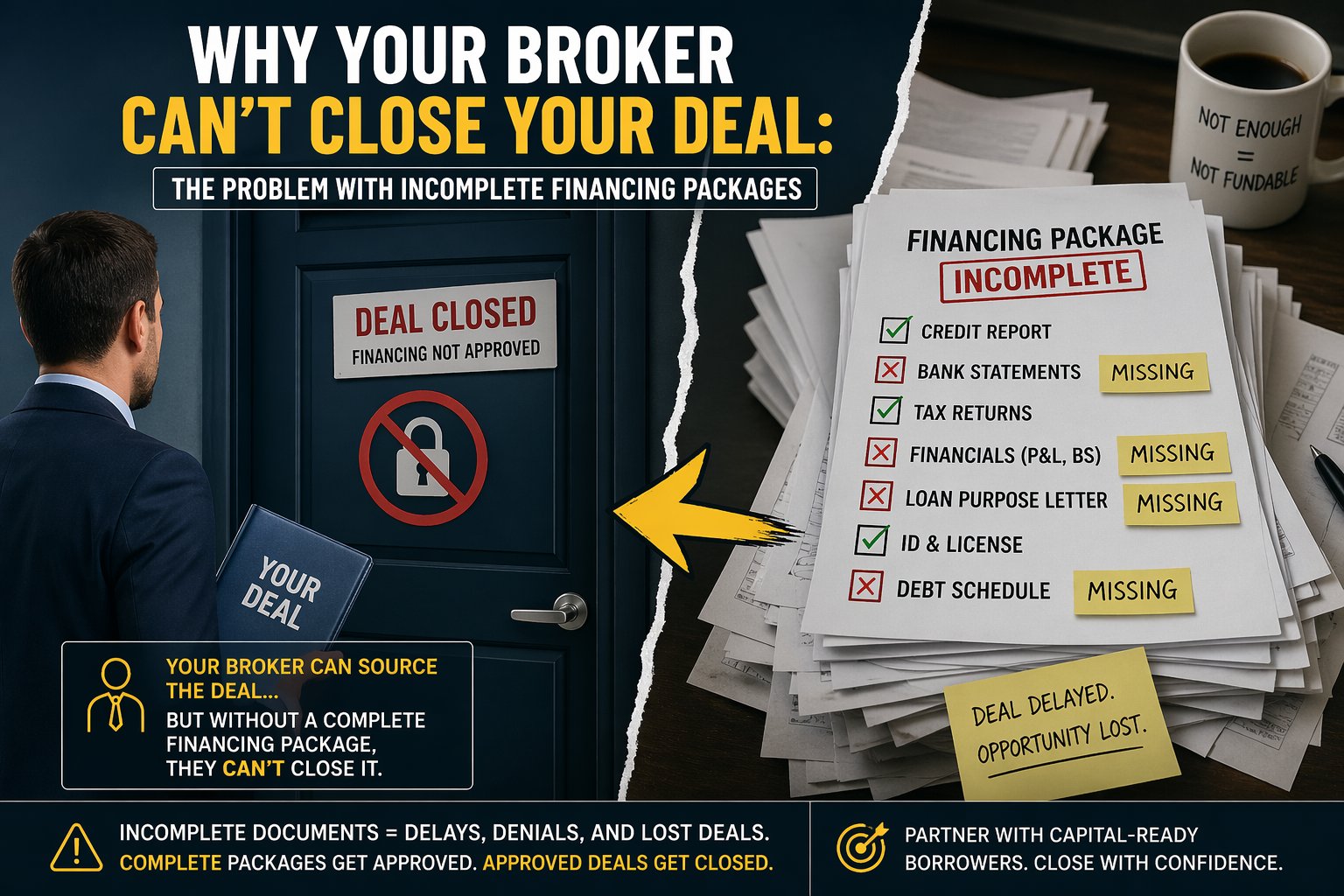
You submitted stacks of financials, appraisals, rent rolls, and still heard the same line from your broker: “The lender passed.”
The deal looked complete, yet it died in committee.
In commercial real estate and corporate lending, a broker often fails to close because the file is an incomplete financing package in lender terms. That can mean missing or outdated documents, or a capital stack that does not fully fund the project. Either way, credit teams at banks like RBC or BMO cannot sign off, so the broker has nothing to close.
This article explains how lenders define completeness, why raw document forwarding is not structuring, and how capital stack gaps kill otherwise sound deals. It also sets out what a bank-ready package looks like in the Canadian market and where Equis Capital Finance fits.
Read this before you send another “everything is attached” email.
Key Takeaways
- A large volume of documents can still be incomplete. Lenders expect structure, clarity, and coherence in the way information is presented.
- Structural gaps in the capital stack are fatal. Missing money matters. Lenders see unfinished funding as construction and completion risk.
- Qualitative gaps are harder to spot. Numbers may exist. Assumptions may not. Credit teams reject files that do not hold together.
- Broker forwarding is not structuring. Many act as couriers. Very few write investor‑grade narratives.
- Expert intermediaries change outcomes. Firms such as Equis Capital Finance speak lender language and align files with real underwriting practice.
What Lenders Actually Mean When They Flag An Incomplete Financing Package

When Canadian lenders say a file is an incomplete financing package, they mean it fails their underwriting test on both content and structure. The package either lacks required documents or leaves obvious economic holes unsolved. Both issues block approval, regardless of how strong the underlying asset looks.
From an administrative angle, banks like TD, Scotiabank, and credit unions expect a full suite of financial statements, tax filings, rent rolls, appraisals, environmental reports, and guarantor information. Guideline B‑20 from OSFI requires federally regulated lenders to apply consistent, documented standards, so missing data is not a minor issue. Underwriters cannot even start their models without it.
From a structural angle, lenders scan the capital stack first. If senior debt, equity, and any mezzanine or vendor paper do not fully cover project cost, institutions such as pension funds or insurance companies will not risk partial funding. Research from CBRE notes that construction lenders often cap loan‑to‑cost around the mid‑60 percent range, so the remaining capital must be clearly sourced.
Lenders also read the submission as a proxy for management quality. A disordered, piecemeal file from a broker signals weak internal controls long before anyone calculates Debt Service Coverage Ratio. According to Deloitte, poor financial data quality is one of the most common reasons financing processes stall or reprice. When a broker sends raw documents with no coherent story, underwriters see execution risk, not just paperwork gaps.
As one senior commercial lender put it, “The way a file is assembled often tells us as much about the sponsor as the numbers do.”
The Difference Between Structural And Qualitative Incompleteness
Structural incompleteness is the obvious version of an incomplete financing package. Key documents are missing outright. Typical examples include:
- Corporate T2 returns without GIFI schedules
- Commercial mortgage requests with no current rent roll
- Multi‑family deals with no recent Phase I Environmental Site Assessment
- Operating companies with no Personal Net Worth statements for guarantors
- No current CRA statements of account for key entities
In these cases, intake staff at banks and credit unions cannot clear the file into underwriting, so it stalls before anyone models cash flow or security.
Qualitative incompleteness is harder to spot and often more damaging. The documents exist, but the content is shallow, inconsistent, or impossible to underwrite. Common signs include:
- Projections with no clear drivers that tie to historical numbers
- A Use of Funds page that bundles millions of dollars into generic working capital with no breakdown
- Aged accounts receivable reports that lump all accounts over ninety days into one line, leaving banks such as CIBC or National Bank unable to assess collection risk
- Business plans that describe growth but never link that growth to specific line items in the financials
These qualitative gaps often pass initial intake because a checklist shows “document received.” They collapse later at credit committee, where risk officers and senior underwriters ask detailed questions the file cannot answer. At that point, time is lost, rate holds may expire, and the broker has little room to recover.
How Capital Stack Gaps Quietly Kill Otherwise Viable Deals

Capital stack gaps are one of the most common reasons a broker cannot close, even when the paperwork appears thorough. A lender sees an incomplete financing package the moment total committed capital fails to meet total project cost. No amount of extra documents fixes an empty layer in the stack.
Consider a $20 million commercial construction project in Toronto. A Schedule I bank agrees to provide senior debt at 65 percent loan‑to‑cost, or $13 million. The sponsor group brings $4 million in equity. That leaves a $3 million shortfall. Without committed mezzanine debt, a Mortgage Investment Corporation facility, or a Vendor Take‑Back mortgage, the capital stack is structurally incomplete.
Senior lenders will not fund their portion into that gap. Institutions supervised by OSFI are acutely aware of completion risk, and research from KPMG highlights that cost overruns and funding gaps are leading drivers of project distress. From the credit desk at a bank or life company, a missing 15 percent is not a minor item; it is a potential foreclosure scenario.
There is an old project‑finance line: “Projects don’t fail at 90% complete; they fail when the last 10% of the money isn’t there.”
Unaddressed capital stack gaps also say something about the sponsor and broker. Either they did not recognise the shortfall, or they recognised it and had no credible path to fill it. Both readings erode confidence. Private lenders, family offices, and debt funds see the same issue: if the sponsor cannot organise a complete structure at submission, what happens when construction schedules slip or leasing takes longer than planned?
For business acquisitions, the same logic applies. A term sheet that assumes a Vendor Take‑Back but has no signed vendor agreement is incomplete. A corporate refinance that relies on future asset sales without clear contracts in place is incomplete. When a broker presents that kind of file, the deal rarely fails on interest rate or covenant requests; it fails because the money needed to close never fully exists in the first place.
Why Brokers Forward Raw Documents Instead Of Structuring A Deal
Brokers often forward raw documents instead of building a lender‑ready narrative because their role is framed as deal finder, not deal architect. Many independents understand rate grids and basic loan terms, yet have limited training in institutional underwriting. The result is a courier model, where whatever the borrower emails is bundled and sent to banks or private lenders.
Most mid‑market sponsors do not employ a full‑time Chief Financial Officer. The operating team and external accountant prepare numbers for tax, not for credit. When a broker receives these materials, they may not have the skill set to reconcile historical anomalies, explain one‑time losses, or articulate why a lower DSCR year does not reflect forward risk. Underwriters at institutions such as BDC or large credit unions then receive a file with gaps they are expected to solve.
Information asymmetry adds another layer. Lender mandates move with Bank of Canada cycles, sector exposures, and updates to OSFI rules such as B‑20. What passed intake at a bank in Vancouver twelve months ago may now require higher stress‑test rates, tighter covenant packages, or different recourse. Without close, current relationships inside those institutions, many brokers work off outdated checklists.
According to BDC, a significant share of Canadian small and mid‑sized firms report difficulty accessing financing on the terms they expect. One driver is misalignment between what borrowers submit and what lenders now require. A broker who simply forwards a document dump does not correct that misalignment; they just move the problem into a different inbox.
What A Lender-Ready Package Actually Requires – And Where Equis Capital Finance Comes In

A lender‑ready file is the opposite of a loose, incomplete financing package. It is a coherent business case arranged in the same order underwriters at banks, MICs, and private funds use to build their models. The data is complete, but more important, the story is internally consistent across financials, projections, security, and capital structure.
For a Canadian commercial real estate or corporate file, that means at least three core elements:
- Aligned historicals and tax filings
Historical financial statements from a firm such as MNP or PwC must align with filed tax returns and current interim results. Material variances need short, plain‑language explanations, not silence. - Pro forma projections with clear assumptions
Projections require written assumptions that bridge from history to future, including rent steps, operating margin shifts, working‑capital changes, and interest‑rate stress tests. Lenders must be able to trace every major line item back to a driver. - Current third‑party reports that match the model
Third‑party reports such as AACI appraisals, Phase I or Phase II ESAs, and Building Condition Reports must be current and match the numbers used in the model. If the appraisal shows one net rentable area and the cash‑flow model shows another, trust erodes fast.
Sponsors often miss a fourth element: a concise Information Memorandum that pulls those pieces into one argument. This is where many brokers fall short and where Equis Capital Finance works by design. With more than twenty years in originating, structuring, and closing commercial loans above $1 million across Canada and the United States, Equis Capital Finance prepares investor‑grade narratives that reflect how real credit committees think.
A lender‑ready package typically contains the following elements in structured form:
- Integrated data room
An integrated data room holds historical financials, tax filings, rent rolls, legal documents, and third‑party reports in consistent naming formats. Underwriters at institutions such as Sun Life or Manulife can find what they need in minutes, not hours, which shortens review time and signals internal control. - Detailed memorandum
A detailed memorandum explains the business model, management, market context, use of funds, capital stack, and exit plan. It anticipates questions about covenant risks, renewal cliffs, or prior losses, rather than waiting for a Request for Information cycle that drags on for weeks. - Capital stack summary
A capital stack summary sets out all layers of funding with terms, sources, and status. Senior debt, mezzanine, vendor paper, equity, and any government programs such as the Canada Small Business Financing Program appear on one page, so a lender can see there is no hidden gap.
Equis Capital Finance draws on relationships with banks, credit unions, pension funds, and private capital groups across North America to match this structure with current mandates. The goal is simple: no underwriter should have to guess, fill blanks with worst‑case assumptions, or wonder who funds the last dollar of the project.
The Real Cost Of Getting This Wrong

Submitting an incomplete financing package does not only slow a deal; it changes its economics. When information is thin or inconsistent, lenders respond by cutting loan proceeds, raising rates, tightening covenants, or declining altogether. Sponsors then scramble toward higher‑yield private loans simply to meet firm closing dates.
In commercial real estate and mid‑market corporate finance, that repricing compounds over time. According to Moody’s Analytics, even small increases in credit spreads can materially reduce project returns across long loan terms. A borrower who might have cleared a bank loan at competitive pricing with a complete file may end up locked into expensive bridge debt or distressed refinancing instead.
There is also the hidden cost of reputation. Credit teams share views on sponsors and intermediaries who repeatedly submit disorganised, under‑prepared packages. Over time, those names draw less attention, slower responses, and tougher questions. When a genuinely strong opportunity arises, the prior pattern of incomplete files still shapes how quickly and how positively lenders react.
Positioning Your Deal The Way Lenders Underwrite It

Positioning a deal the way lenders underwrite it means building completeness into both documentation and capital structure. It means treating the financing package as a strategic instrument, not a compliance exercise. Brokers who only pass documents through cannot meet that standard.
An experienced intermediary such as Equis Capital Finance starts from the same place an underwriter at a bank or institutional lender starts. The team tests the internal logic of historical results, stress‑tests projections, challenges the capital stack, and checks that every third‑party report aligns with the story. That work happens before the file reaches RBC, TD, or a private debt fund, not after a decline.
If you are preparing to raise capital and want to present your deal the way lenders actually assess it, Equis Capital Finance can walk you through that process. The objective is not a thicker package; it is a complete, coherent one that gives serious credit committees clear grounds to say yes.
Frequently Asked Questions
Question: What is an incomplete financing package in commercial lending?
An incomplete financing package is a submission that fails lender requirements either structurally or qualitatively. Structurally, key documents or capital layers are missing. Qualitatively, the information is shallow, inconsistent, or cannot support stress testing. Lenders treat both forms as separate reasons to delay, reprice, or decline a deal.
Question: Why do lenders reject complete‑looking applications?
Lenders reject complete‑looking applications when qualitative gaps surface during deep review. Projections may not tie to history, capital stack details may be vague, or third‑party reports may conflict with stated assumptions. Underwriters then insert conservative estimates, which reduce loan size or make the risk profile unacceptable.
Question: What is a capital stack gap and why does it matter?
A capital stack gap is the shortfall between total project cost and the combined commitments of senior debt, mezzanine, vendor paper, and equity. Senior lenders will not fund into that hole. Without a fully subscribed stack, institutions view the risk of incomplete construction, unpaid suppliers, or distressed sale as too high.
Question: How does an experienced intermediary improve deal outcomes?
Experienced intermediaries audit documents before submission, identify missing items, and align the file with current lender expectations. They prepare a structured memorandum, explain financial anomalies, and confirm that every capital layer is sourced. This reduces Requests for Information, shortens timelines, and raises the chance of competitive, bank‑grade terms.
Question: What types of transactions does Equis Capital Finance typically work on?
Equis Capital Finance focuses on commercial financings over $1 million across Canada and the United States. Typical mandates include multi‑family and commercial real estate, project finance, corporate growth capital, recapitalisations, and structured credit. The firm works with banks, credit unions, private capital groups, and institutional investors to complete these transactions.
Conclusion
When a broker cannot close, the problem is rarely just “tight credit conditions.” The deeper issue is that the file presented to lenders is an incomplete financing package by institutional standards. Either the documents do not give underwriters what they need, or the capital stack itself leaves clear funding gaps.
Lenders use submissions to judge both risk and sponsor discipline. Disordered, partial, or poorly argued packages lead to smaller loans, higher pricing, and in many cases, outright declines. The cost is measured not only in basis points, but in missed acquisitions, stalled projects, and reputational drag across the lending community.
Sponsors who treat their financing package as a strategic asset position themselves very differently. With a structured approach to documentation and capital architecture, guided by an intermediary such as Equis Capital Finance, they present clear, complete cases that reflect real underwriting practice. That is the difference between a broker who forwards documents and a partner who closes transactions.