Introduction
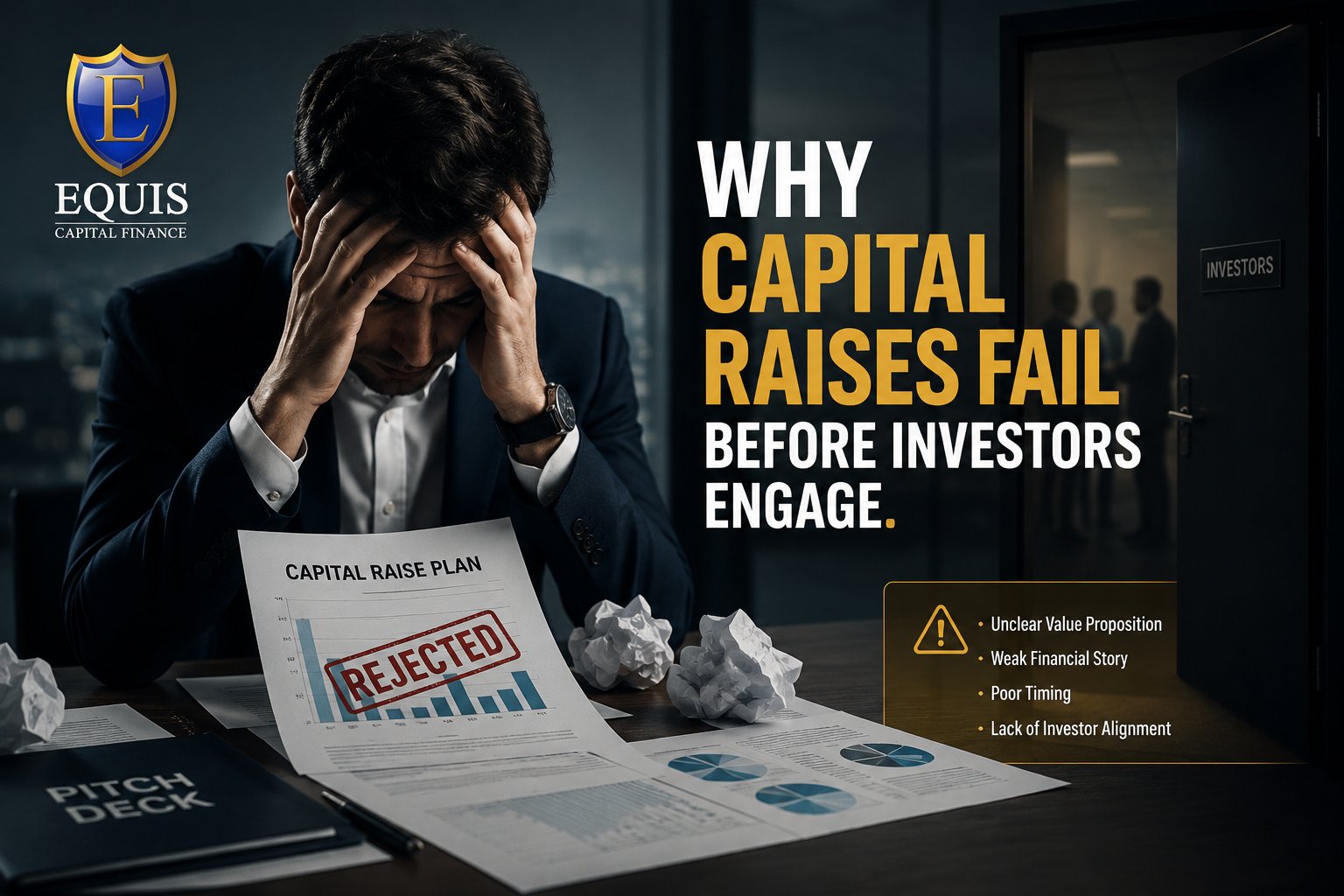
Most capital raises fail before investors even open a deck because the preparation is below an institutional standard. Owners often ask why a raise stalls when the business itself seems solid; the real problem sits in what investors see first, not in the asset or idea.
Weak documentation, fuzzy numbers, and a confused capital strategy cause silent rejection long before a meeting. According to CB Insights, 38 percent of failed startups cite running out of cash or an inability to raise more.
This article shows how to avoid those capital-raise mistakes by focusing on readiness, structure, and investor expectations. The sections that follow outline the main preparation gaps, what investors actually test for, and how Equis Capital Finance helps Canadian businesses become investor-ready long before you hit send on your next deck.
Key Takeaways
These points show why most raises stall before investors give them serious time.
- Institutional readiness gap. Documents look basic or incomplete. Serious investors move on quickly, so deals end before they begin.
- Misaligned capital strategy. Owners chase the wrong money source; structures do not fit the deal, so time and trust get wasted.
- Documentation failures. Executive summaries feel vague and use of proceeds is unclear, so investors cannot see how cash turns into results.
- Shopping the deal. The same weak deck hits every inbox, word spreads in a small market, and perceived deal quality falls fast.
- Confusing lenders with investors. Banks see equity-style risk, equity funds see bank-style terms, and both groups decide to pass.
Why Most Capital Raises Are Dead On Arrival

Most capital raises are dead on arrival because poor preparation disqualifies deals before anyone takes a serious look. Investors at banks, credit unions, private equity funds, and family offices use quick screens that filter out most submissions in minutes.
Those early screens check document quality, numbers, deal structure, and basic fit. If the package feels rushed or incomplete, it never reaches a credit committee or investment partner. Recent data from PitchBook shows that global venture funding has fallen by roughly 40 percent from 2021 levels, so investors now see far more deals than they can fund.
For a Canadian small business or real estate project, that competition raises the bar. Investors at firms like RBC, BDC, or a private lender in Vancouver expect investor-grade material from the start; if they spot missing financials or a messy cap table, they move on without comment. According to Innovation, Science and Economic Development Canada, about 60 percent of new Canadian small businesses survive at least three years, which underlines how tight margins can be. When a capital raise stalls for months because of early preparation errors, that survival window shrinks. Understanding these early failure points is the first step to fixing your next raise.
The Five Preparation Mistakes That Kill Capital Raises
The five preparation mistakes that kill capital raises all happen before the first investor meeting. They explain why capital raises fail even when the project looks strong on paper.
Most owners focus on the pitch meeting or a specific investor they want to reach. In practice, the bigger risk is never making it past the front desk. Structural gaps, weak summaries, mismatched capital types, and undisciplined outreach slowly erode investor trust.
The good news is that these are controllable problems. With a clear capital strategy, Canadian business owners and developers can fix them before sending a single email. Equis Capital Finance builds its advisory work around closing exactly these gaps.
Mistake 1: No Institutional Readiness Or Investor-Grade Documentation

Mistake 1, no institutional readiness or investor-grade documentation, blocks deals at the very first screen. Investor-grade means your material looks and reads like what a bank credit team or private equity analyst expects.
At minimum, most institutional funders expect:
- Concise business plan with a clear revenue model and risk discussion
- Three- to five-year financial projections that tie back to historicals
- Detailed project budget and capital structure table
- Offering or credit memorandum and a focused investor deck for larger raises
When these pieces are missing, inconsistent, or copied from old versions, investors assume operational inexperience. A study from Startup Genome links premature scaling and weak financial discipline to failure in many startups, which reinforces this point.
Equis Capital Finance supports clients by preparing full documentation packages that meet the standards of banks, pension funds, and private lenders across North America.
Mistake 2: A Weak Executive Summary And No Defined Use Of Proceeds
Mistake 2, a weak executive summary and no defined use of proceeds, kills a raise inside the inbox. Many investors only read this one- to two-page overview before deciding whether to ask for more.
A strong summary is not a brochure; it is a filter document that answers:
- Who you are
- How much you need
- Why now
- How and when the investor gets paid back
It should also spell out, line by line, how new capital will be used and which milestones it will fund.
When the use of proceeds is vague—phrases like general working capital or growth—investors cannot model risk or return. That lack of clarity is one of the fastest reasons they pass on deals without giving feedback.
Mistake 3: Confusing Lenders With Investors — And Misaligning The Capital Structure

Mistake 3, confusing lenders with investors and misaligning the capital structure, wastes months and harms your reputation. Debt and equity have very different jobs.
Banks and asset-based lenders look for predictable cash flow, hard collateral, and clear repayment plans. They sit higher in the structure and accept lower returns for lower risk. Equity investors, such as venture capital funds or family offices, accept more risk in exchange for ownership and upside.
When a business that fits a bank product approaches a venture fund, or a venture-stage startup asks a bank for growth equity, both sides see a poor fit. Equis Capital Finance helps clients decide whether senior debt, mezzanine debt, or equity fits the project before any approach to BDC, EDC, or private capital groups.
Mistake 4: Sending Decks Too Early And “Shopping The Deal”
Mistake 4, sending decks too early and shopping the deal, quietly poisons the market. Shopping the deal means blasting the same unqualified pitch to every lender and investor you can find.
Canada has a relatively small investment community. Firms at the Canadian Venture Capital and Private Equity Association, major banks, and private lenders all talk to one another. When several of them see the same weak deck, the deal quickly gains a poor reputation. Once a deal is widely seen as “shopped,” many investors assume others have already found reasons to decline.
A better method is relationship first, documents second. You research each funder, confirm sector focus, stage, and cheque size, and only then share a refined deck. Equis Capital Finance uses a structured outreach process so that clients reach the right desks without burning goodwill.
What Investors Actually Look For Before They Say Yes

What investors actually look for before they say yes is a consistent set of signals across the story, numbers, team, and structure. Different funders may use different language, yet the framework is similar.
First, they want a clear narrative that matches real market data: a defined customer, a real problem, a practical solution, and evidence of demand. Reports from groups like Deloitte show that investors place high value on proven revenue quality, not just projections.
Second, they test financial quality. Institutional lenders and funds review historical statements, forward projections, and unit economics such as margin and payback, and compare them with sector benchmarks from sources like KPMG Canada and CVCA industry reports. Any large gaps must be explained in plain language.
Third, they look at the team and governance. Investors back people they trust to handle risk, not just spreadsheets. A small business in Halifax or a property developer in Vancouver that can point to experienced managers, a functioning board or advisory group, and clean legal records will move ahead faster.
Finally, they assess deal structure and preparation behaviour. If a founder has a realistic valuation, a sensible mix of debt and equity, and a tidy data room ready for investor due diligence, that sends a strong signal. Those signs of discipline often matter as much as the headline idea when investors decide who reaches the term-sheet stage.
“Risk comes from not knowing what you’re doing.” — Warren Buffett
Serious investors use these signals to judge whether you know exactly what you are doing with their capital.
How Equis Capital Finance Helps Businesses Get Capital-Ready

Equis Capital Finance helps businesses get capital-ready by fixing the preparation gaps that cause silent rejection. The firm focuses on documentation, capital structure, and access to the right funding partners.
On the documentation side, Equis Capital Finance works with clients to build concise business plans, detailed financial projections, and investor presentations that meet institutional standards. This support covers small businesses in manufacturing, real estate developers in cities like Edmonton, and consulting or financial services firms across Canada. The goal is a package that passes the first screen with banks, credit unions, and private funds.
On the structuring side, Equis Capital Finance helps owners choose the right mix of senior debt, subordinated or mezzanine debt, and equity for each project. That guidance matters when approaching partners such as BDC, EDC, pension funds, or private lenders, because a well-arranged structure makes it far easier for each capital source to say yes.
Access is the third pillar. With more than twenty years of front-line experience, Equis Capital Finance maintains relationships with banks, insurance companies, pension plans, trust companies, and non-bank lenders across North America. The firm’s Construction Finance Group and Private Capital Group give owners a path forward even when traditional lenders say no.
By combining preparation, structure, and market reach, Equis Capital Finance helps clients avoid the common reasons why capital raises fail and move toward closings that actually fund.
Laat Jou Kapitaalreis Nie Misluk Voordat Dit Begin Nie
Laat jou kapitaalreis nie misluk voordat dit begin nie speaks to the central point: most raises fail long before investors review them. The fix is not a flashier pitch; it is better preparation.
When you close the institutional readiness gap, define a coherent capital strategy, and write an executive summary with a precise use of proceeds, you change how investors see the deal. When you stop shopping the deal and match lenders or investors to the right structure, you protect your standing in a close-knit Canadian market.
If this article sounds uncomfortably familiar, it may be time to get help before your next round. Equis Capital Finance can work with you to become truly investor-ready, then introduce you to suitable funding partners. To learn more, visit equisfinance.com.
Frequently Asked Questions
Question 1: What Does “Investor-Ready” Actually Mean For A Small Business Or Real Estate Developer?
“Investor-ready” means your business has complete documents, a clear capital strategy, and a structure that fits the right funding source. That usually includes a concise business plan, reliable financial projections, and a detailed credit or offering memorandum. When those pieces align, investors can review and price your deal far more easily.
Question 2: Why Do Investors Pass On Deals Without Giving Feedback?
Investors often pass on deals without feedback because most rejections happen at the document filter stage. Weak executive summaries, missing financials, or mismatched capital structures send a clear signal that the deal is not ready. Busy investors rarely have time to explain those issues one by one.
Question 3: What Is The Difference Between A Lender And An Investor, And Why Does It Matter For A Capital Raise?
A lender provides debt and expects regular repayment with interest, usually backed by assets or cash flow. An investor provides equity, takes ownership, and expects returns from growth and exit value. Sending a deal to the wrong group wastes time and suggests the sponsor does not understand capital markets.
Question 4: How Early Should A Business Start Preparing For A Capital Raise?
A business should start preparing at least six months before any outreach. That window gives time to refine financial models, complete investor-grade documents, and define a clear capital strategy. When those pieces are ready before first contact, investor meetings focus on fit instead of basic fixes.
Question 5: What Is “Deal Shopping” And Why Does It Hurt A Capital Raise?
Deal shopping means sending the same untargeted pitch to many investors or lenders at once. In Canada’s small investment community, that behaviour builds a poor reputation and lowers perceived deal quality. It also reduces urgency because funders assume others have already declined or found problems.